Part of a painting showing an ancient egyptian lady bowing in front of an altar, with burning incense.on the wall behind her are traditional egyptian scenes of offering tables with servants bringing food to lay on them

‘Animal mummies’ exhibition at the Manchester Museum

Stuffed animals from Egypt such as an ibis, a monkey, a falcon and a large cat Stuffed animals from Egypt such as an ibis, a monkey, a falcon and a large cat
A coffin in the shape of an ibis A coffin in the shape of an ibis
Bird footprint stickers on the floor, leading you around the exhibition Bird footprint stickers on the floor, leading you around the exhibition
The pharaoh stands between the falcon-head god Horus and the ibis-headed god Thoth. They are surrounded by hieroglyphs. Next to the cast is a pillar covered in hieroglyphs The pharaoh stands between the falcon-head god Horus and the ibis-headed god Thoth. They are surrounded by hieroglyphs. Next to the cast is a pillar covered in hieroglyphs
A tunnel-like construction with niches in the walls with artefacts in them. At the end of the tunnel is a man and a young girl just exiting A tunnel-like construction with niches in the walls with artefacts in them. At the end of the tunnel is a man and a young girl just exiting
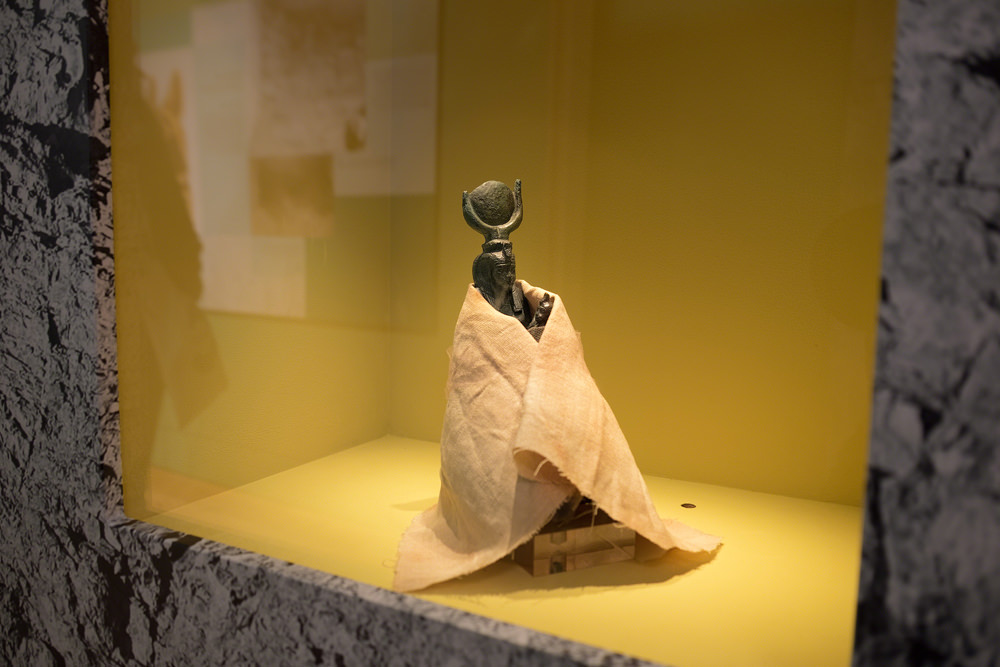
The statue is a few inches tall and mostly covered by the piece of plain, white linen. Only the heads of Isis and Horus are visible. The statue is places in a yellow-coloured square niche The statue is a few inches tall and mostly covered by the piece of plain, white linen. Only the heads of Isis and Horus are visible. The statue is places in a yellow-coloured square niche
A square slab of limestone with food and drink carved into the top. There are two square indentations towards the top and another running around the edge of the slab A square slab of limestone with food and drink carved into the top. There are two square indentations towards the top and another running around the edge of the slab
Three large paintings mounted on the wall. The camera is looking at them from an angle, and there are two people walking through the gallery Three large paintings mounted on the wall. The camera is looking at them from an angle, and there are two people walking through the gallery
Two people hold amulets of deities. There is a statue of a bull with a headdress in the background Two people hold amulets of deities. There is a statue of a bull with a headdress in the background
A person is holding a cat for another person to look at whilst carving a statue of a cat A person is holding a cat for another person to look at whilst carving a statue of a cat
A woman with an ibis on her shoulder. The ibis is eating from a plate of food in the woman's hand A woman with an ibis on her shoulder. The ibis is eating from a plate of food in the woman's hand
Five framed portraits of Egyptologists and collectors from the 19th century. The caption above quotes 'It would hardly be respectable on one's return from Egypt, to present oneself in Europe without a mummy in one hand and a crocodile in the other'. Five framed portraits of Egyptologists and collectors from the 19th century. The caption above quotes 'It would hardly be respectable on one's return from Egypt, to present oneself in Europe without a mummy in one hand and a crocodile in the other'.
Campbell is kneeling in front of one of the cases, smiling, and looking at the exhibits Campbell is kneeling in front of one of the cases, smiling, and looking at the exhibits
Some fur and teeth are still visible. The eyelids are closed and the ears stuck close to the cheeks Some fur and teeth are still visible. The eyelids are closed and the ears stuck close to the cheeks
Three computer screens sit atop a long desk with information panels behind them Three computer screens sit atop a long desk with information panels behind them
The bird mummy is in a clear, rectangular case with a metal scanner sitting over the top of part of the case. The bottom of the screen next to it is just visible at the top of the photo. The bird is being scanned and you can see the bright lines of the scanner on the mummy The bird mummy is in a clear, rectangular case with a metal scanner sitting over the top of part of the case. The bottom of the screen next to it is just visible at the top of the photo. The bird is being scanned and you can see the bright lines of the scanner on the mummy
The mummy wrappings are intricately done in diamond shapes with an ibis head modelled at the top and a crown extending from the back of the neck The mummy wrappings are intricately done in diamond shapes with an ibis head modelled at the top and a crown extending from the back of the neck
The jackal is plain limestone with paint around the eyes only. It has very long, pointed ears. In the background is a cat mummy The jackal is plain limestone with paint around the eyes only. It has very long, pointed ears. In the background is a cat mummy
A young girl is writing a message with a pencil. Just in front of her are the three metal embossing stamps. Each one has a lever sticking out the top to work the stamp A young girl is writing a message with a pencil. Just in front of her are the three metal embossing stamps. Each one has a lever sticking out the top to work the stamp
A young girl holds a piece of paper out, partially obscuring her face. She has drawn a rabbit and written 'pet bunny' on it. She has embossed it with a cat A young girl holds a piece of paper out, partially obscuring her face. She has drawn a rabbit and written 'pet bunny' on it. She has embossed it with a cat
A young girl holds out a piece of paper with an ibis drawn on it A young girl holds out a piece of paper with an ibis drawn on it
A profile picture of the head and shoulders of Campbell. He's looking at his phone, typing something into it A profile picture of the head and shoulders of Campbell. He's looking at his phone, typing something into it


On 15 April 2016, we had a family trip to the Manchester Museum to see the Animal Mummies: Gifts for the Gods exhibition.

It was closing two days later, and moving on to the Kelvingrove in Glasgow. I’d offered to come and get a few photos to document the exhibition for Campbell Price, Curator of Ancient Egypt and Sudan (a friend of mine from my university days). I also did a brief interview with Campbell, about how the exhibition had gone, for my other blog, which you can read here.

The theme of the exhibition was the mummification of animals in Ancient Egypt – why they were mummified and the religious cults with which they were associated. The exhibition also covered the more modern archaeological history of animal mummies and the recent scientific research that’s been done on them.

It was a great exhibition; there was lots to see and learn, including:

  • how the Egyptians mummified animals
  • a reconstructed catacomb with statues and an offering prayer being read out in the Ancient Egyptian language
  • a modern bird mummy that had been mummified by researchers that you could watch being scanned in real time
  • masterpieces from the 19th century depicting Ancient Egyptians with animals
  • smells of the mummification process; researchers had found that honey, pine and incense had all been used in mummification, and samples of these were available to smell
  • a corner where you could write a message to the gods and emboss it with a hieroglyphic embossing stamp


The photography

It was a slightly tricky exhibition to photograph; as with many exhibitions, much of it was in lower light, with pieces accentuated by spotlights. This kind of lighting makes for a great atmosphere in the exhibition, but can be tricky to photograph without losing either shadows or brighter spots.

Also, the lower light meant I had to use a much wider aperture, but that means I had to sacrifice depth of field.

Ideally, I would like to have had the chance to do some focus stacking and bracketed exposures, but I was there while the exhibition was open, and it wasn’t often I got a moment when there weren’t other people in there moving around. And when I did, it wasn’t long enough to get more than a single shot.

I also had to be mindful of the fact that I was in there with a tripod and to not place it where other visitors might trip over it.

However, all things considered, I think my camera did very well in the low-light conditions and I got some good shots. I was particularly pleased with how the closeup shots of the 19th century paintings came out; I did those hand-held and they are really very clear and noise-free.


The exhibition is now showing at the Kelvingrove Art Gallery and Museum in Glasgow and is on until September. It’s then moving on to the World Museum in Liverpool, where it will be showing from October 2016 until March 2017. I’ll be back to revisit in Liverpool and will hopefully share some more photos. It’ll be interesting to see how the same exhibition looks in different venues.


[Edit, 2 November 2016: here are some behind-the-scenes photos of the exhibition being set up at the World Museum in Liverpool.]

Like
Like Love Haha Wow Sad Angry
1

Similar Posts

  • Fujifilm XF16mm f1.4 lens up close and personal

    At the beginning of October 2016, I bought myself the Fujifilm XF16mm f/1.4 lens (24mm equivalent on full-frame sensors). My reasoning was that I needed something wider than my 35mm for those situations when you don’t have room to step back to capture a scene, such as shooting in small spaces or busy environments. It’s also quite useful to not have to walk halfway down the street to get the whole of a building in shot.

    And, I can’t deny that since then it’s really helped me out in those situations.

  • |

    Liverpool Psych Fest: food, festival goers and musicians

    Liverpool Psych Fest – or, to give it its proper name, Liverpool International Festival of Psychedelia – was on in the Baltic Triangle area of Liverpool on 23 and 24 September this year.

    Two friends of mine were running one of the food outlets at the festival and they asked me to come along and get some photos of them working and of some of their dishes.

  • Liverpool Pier Head

    The Pier Head in Liverpool is a popular tourist destination, and it’s where you’ll find the Three Graces (the Royal Liver Building, the Cunard Building and the Port of Liverpool Building).

    In more recent years, it’s also become home to the Museum of Liverpool. Opened in 2011, it’s now one of Liverpool’s most popular museums, documenting the city from it prehistoric roots right through to the present day. It’s a really great museum with lots to see and loads of interactive bits and pieces for the younger visitor to enjoy.

    But what I’m posting about here is not so much what’s inside the museum, but what you can see from it. At both sides of the building on the top floor are sets of huge windows looking out over the Pier Head and the Albert Dock. The views are fantastic.

  • Visiting the Roman Baths: the good and the bad

    The Roman Baths is the jewel in the crown of the city of Bath. Built on geothermal underground springs, the baths are filled with water that comes out of the ground at 46°C,

    The Celts were the first people to build shrine at the site, which they dedicated to the goddess Sulis.

    When the Romans invaded Britain in the first century AD under the Emperor Claudius, they renamed the settlement Aquae Sulis, identifying Sulis with the Roman goddess Minerva, and built their own temple and baths complex at the springs.

  • Charlcombe Church: Bath’s oldest church

    Charlcombe Church (or, the Parish Church of St Mary the Virgin, Charlcombe, to give it its official name) is Bath’s oldest church and the place of many great childhood memories for me.

    Although it underwent extensive work in the 19th century (including the addition of the vestry on the north side and the stained-glass windows), the church was first built during Norman times. It’s a tiny church, but has enormous character. Here’s a few fun facts about it.

Subscribe
Notify of
guest
1 Comment
Newest
Oldest Most Voted
trackback

[…] The Animal Mummies Revealed exhibition was on at the Manchester Museum in 2105, which I also visited. You can read my post about it here. […]